
Many healthcare organizations are seeing declines in page views and web traffic. That’s in part because people are getting answers to health questions in AI overviews instead of clicking through to websites. This leaves many healthcare marketers asking:
- How does appearing in AI overviews help my organization?
- How do we get featured in AI overviews?
Here’s what we’ve learned so far — and what you can do about it.
What are AI overviews?
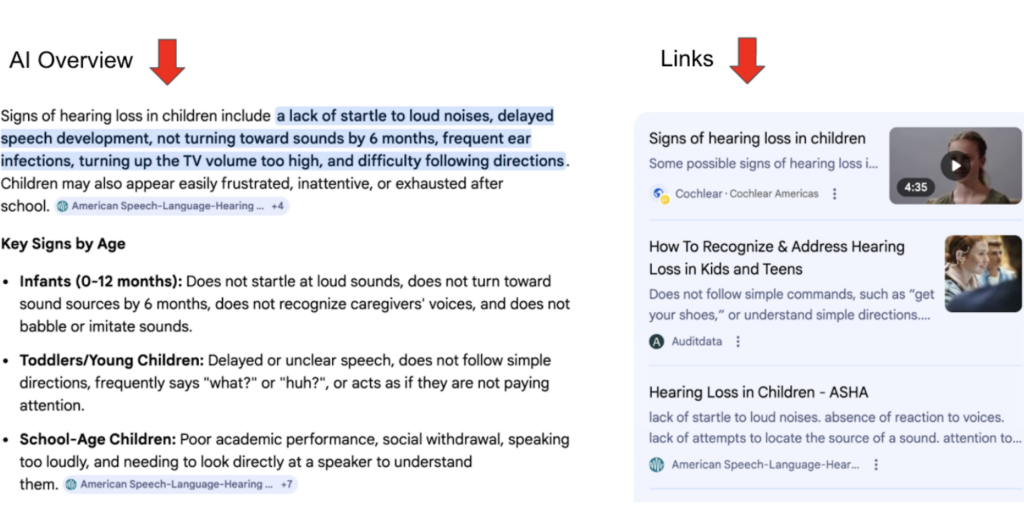
AI overviews are summaries at the top of search results. Instead of traditional links to websites, Google uses AI to pull information from various sources to create a quick and comprehensive answer.
Near the summary, Google often links to the websites it used to generate the response.
How Does Getting Featured in AI Overviews Help Your Organization?
Getting featured in AI overviews helps:
1. Get your name out there
Even if users don’t click your link next to an AI overview, they see your organization’s name and website. That raises awareness that your organization is an expert in the area someone is searching for. You may not get the click — but you do get the impression.
2. Build your reputation as an expert
When your content is featured in an AI overview, it helps people see that your organization is a trusted and credible source on that topic.
3. Get the people who are most interested to your website
The users who click the links next to an overview are often highly interested in what you have to say. They may be more likely to engage further and make an appointment with your organization.
In other words: the quantity of your web traffic might be going down but, if you’re featured in or adjacent to AI overviews, the quality of those web hits is going up.
How to get featured in AI overviews: Best Practices
A person’s journey to your organization often starts with a question — like “what are signs of hearing loss in kids” or “what to do if you think your child has hearing loss.” Creating content that answers the question, demonstrates expertise and is easy to understand can help you get featured in AI overviews according to Google.
Here’s what that looks like.
1. Create content that’s expert and credible
EEAT content (i.e. content that demonstrates experience, expertise, authoritativeness and trustworthiness) is more important than ever with AI overviews, as Google and others are scanning to be sure your information is trustworthy before elevating you into an AI overview. To strengthen your EEAT:
- Interview subject matter experts
- Include quotes from credible sources
- Share original insights or data with citations (i.e. link to a credible source where you found that information. For example, a recent study from Princeton University found that including quotes, citations and statistics could increase your visibility in AI searches by around 40 percent).
- Offer perspectives others aren’t covering
A practical example: A webpage or article about signs of hearing loss in kids should go beyond simply listing those signs. It should interview an audiologist about signs of hearing loss — and go deeper into what they mean and what to do if you see them. You might also:
- List the audiologist as the author of or as a source for the page (with their review and permission)
- Include sections or pull quotes that add depth or insight you haven’t seen in other places. This will help you stand out when Google scans your page for expertise.
For example, a pull quote could be:
“The hearing test at a pediatrician’s office only checks four frequencies, so it’s possible for a child to pass that hearing test but still have a hearing difference,” said Pediatric Audiologist Dr. Suzie Earheart.
2. Answer the Question Immediately
AI systems (and often, humans) prefer a clear and direct answer to a question. For example:
Question: What are signs of hearing loss in babies?
Answer: Signs of hearing loss in babies include:
- Not turning their head toward a sound
- Not startling or waking up when there’s a loud noise
- Not babbling or seeming to know their name by age one
3. Elaborate after answering the question
To get an AI overview, your content should also provide a more comprehensive answer and speak to the person’s search intent or what they are truly hoping to learn. Be sure to consider:
- What does the user really want to know?
- Are they looking for a definition? A how-to? A list of symptoms?
For example, a user may search for “signs of hearing loss in kids.” And they likely want to know more than just those signs — they’ll want to know what to do or where to go if their child has those symptoms, and how a hearing difference may impact their child’s life.
4. Make Your Content Easy to Scan
Real humans and robots alike are partial to:
- Clear headings
- Short paragraphs
- Bulleted lists
- Straightforward language
Takeaways: 4 Quick Tips to Improve AI Visibility
Here are four easy steps you can take to help your organization get featured in AI overviews:
- Add FAQ sections to things like condition and treatment pages, with comprehensive answers that try to touch on everything a user wants to know.
- Use quotes from subject matter experts, especially ones that add new information or provide a distinct perspective not already captured in the main text.
- Include a list of sources or authors, including any SMEs you interviewed.
- Add a simple date stamp to the top of a page. This could be as straightforward as: “This page was updated in April 2026.” For AI overviews, Google prioritizes up-to-date information. Adding a date stamp signals that the content is recent and based on the latest best practices.
Proven Best Practices for a New World
At Message Lab Media, our conversations about AI keep coming back to the idea that “the more things change, the more they stay the same.”
Our world is rapidly changing in the face of AI, but the antidote might just be what many communicators should already be doing: Find the facts, using credible sources and your own experts. Share those facts with empathy for your audience and what they might be going through. And make your information clear, straightforward and easy to understand.
Need help updating your content to capture AI overviews? We’re here to help.